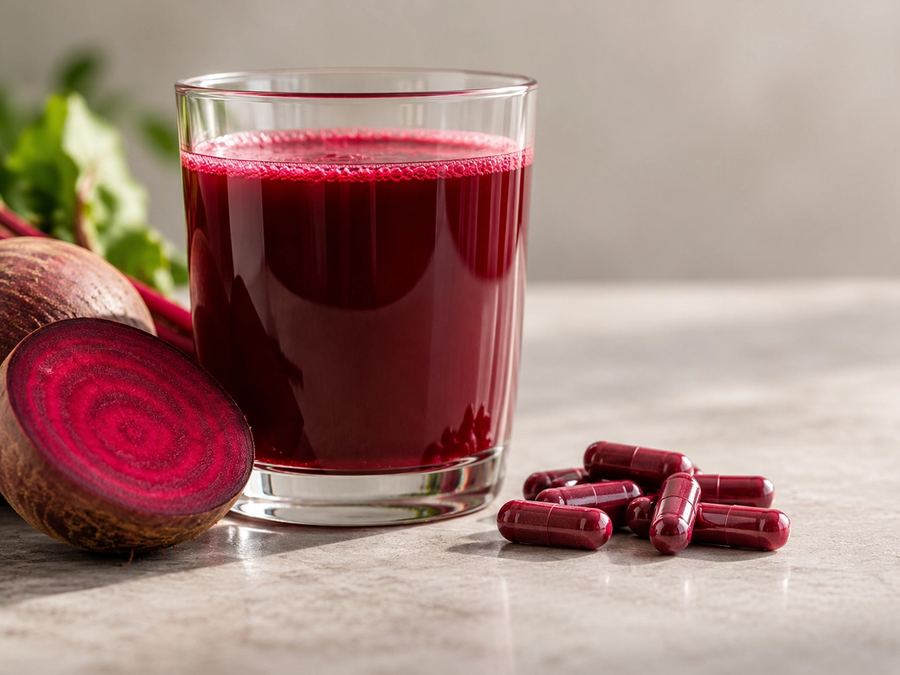
Beetroot, 4 min read
When Is the Best Time to Take a Beetroot Supplement? And How Long Does It Take to Work?
Find out when to take a beetroot supplement, how long it may take to work, and what research on beetroot juice can tell us about timing.
- Written by
- Antonia S, Research & Development
- Published

Wondering when to take a beetroot supplement and how long it takes to work? The answer depends on the type of supplement, what you're hoping to get from it, and how much nitrate it contains. Here's what the science says about timing, daily use and what to look for on the label.
When should you take a beetroot supplement?
There isn't one perfect time to take every beetroot supplement. If you're taking a nitrate-rich beetroot juice product in connection with exercise, research commonly uses a dose around 2–3 hours before activity. If you're taking beetroot capsules as part of your everyday routine, following the product's label consistently is a sensible starting point.
However, the research on nitrate-rich beetroot juice cannot automatically be applied to every beetroot capsule. Products differ in their ingredients and nitrate content, and this can influence how closely they resemble the products used in clinical studies.
How long does it take for a beetroot supplement to work?
This is one of the most common questions people ask about beetroot supplements. The important thing is to distinguish between a measurable change in the body and noticing a difference yourself.
Within a few hours, several days or weeks
Studies of nitrate-rich beetroot juice have found that nitrate levels in the blood can rise within an hour of consumption, while nitrite levels often peak around 2–3 hours afterwards. This is one reason sports nutrition studies frequently investigate beetroot juice taken a couple of hours before exercise.
One study (opens in a new tab) found that nitrate and nitrite levels changed after participants consumed beetroot juice, with nitrite reaching its highest levels around three hours after intake.
Some research has investigated regular beetroot juice consumption over longer periods, rather than a single serving. Researchers have looked at outcomes including blood pressure and exercise performance, with results varying between studies and participants.
A systematic review published in 2024 (opens in a new tab) examined beetroot juice and blood pressure in people with hypertension. It found a reduction in clinical systolic blood pressure in the pooled results, but it is worth noting the results varied between studies.
These findings don't mean everyone will notice a difference after a set number of days, and there is no universal countdown for when a beetroot supplement will start to take effect.
Should you take a beetroot supplement in the morning or evening?
For most people, the best time depends on their routine and the instructions for their particular product.
Taking it in the morning
Taking a supplement with breakfast can be a convenient way to build it into your daily routine. If you prefer taking supplements at the same time each day, choose a time you can stick to.
Taking it before exercise
If your main interest is sports performance, it's worth knowing that research into nitrate-rich beetroot juice often uses a dose approximately 2–3 hours before exercise.
Taking it in the evening
There is no universally established evening time that makes beetroot supplements more effective. Check the product's instructions and choose a time that fits comfortably into your routine. Ultimately, consistency and understanding what your particular supplement contains are more useful than chasing a supposedly perfect time of day.
Do you need to take a beetroot supplement every day?
That depends on the product and your reason for taking it. Some studies investigate a single serving before exercise; others examine daily intake over several days or weeks. These are different approaches, designed to answer different questions.
If you're taking a supplement as part of your daily routine, follow the manufacturer's recommended serving and don't exceed it in an attempt to speed up results.
What should you look for in a beetroot supplement?
The label can tell you quite a lot about what you're buying. Here are a few useful things to check.
1. The actual amount of extract
Look for the quantity of beetroot extract per serving. If a product uses a concentrated extract, check whether the label distinguishes the extract weight from its beetroot powder equivalent.
2. Nitrate information
Nitrate is an important consideration when comparing a supplement with products used in nitrate research. If the manufacturer doesn't state the nitrate content, you can't assume it provides the same dose as a nitrate-rich beetroot juice used in a clinical trial.
3. Other ingredients
Check whether the product contains additional ingredients, such as vitamins or plant extracts, and understand what each ingredient contributes.
4. Clear serving instructions
A transparent label should explain how much to take and how often. More is not necessarily better, and taking extra servings won't guarantee faster results.
Let’s take a look at Beetboost
BeetBoost (opens in a new tab) is designed for people who want a convenient way to include beetroot extract in their routine without preparing beetroot juice or mixing powders.
Each BeetBoost capsule contains:
- 300 mg of 50:1 beetroot extract, equivalent to 15,000 mg of beetroot powder.
- 1,000 µg of vitamin B12.
- Black pepper extract.
The powder-equivalent figure describes the concentration of the beetroot extract; it isn't the amount of extract in the capsule.
BeetBoost is a convenient option if you prefer capsules to juice or powder. If you're comparing products, take a moment to read the ingredient list and serving instructions so you can make an informed choice.
References
- Andrew J Webb et al View source (opens in a new tab)
- Andrew J Webb et al View source (opens in a new tab)